Sunday, August 28, 2011

Book 9 - Romeo's Ex by Lisa Fiedler - Verona, Italy


I love Shakespeare's plays. I love the comedies, the histories and the tragedies and Romeo and Juliet is one of my favourite plays. I also really enjoy fictional adaptations of Shakespearean plays. Lisa Fiedler has taken the minor character of Rosaline and made her into a complex, intelligent and beautiful young woman. No wonder Romeo was infatuated with her. Obviously the story relates to the days surrounding the Capulet ball and Romeo and Juliet's marriage and tragedy. Fiedler takes the story and tells it from several points of view - Rosaline, Benvolio, Tybalt, Mercutio and even Romeo tell their parts of the story as the tragic events unfold. Rosaline has an interest and some skill in the art of healing which makes her role in the conflict one of guardian and protector. Despite her best efforts and those of her newly found allie Benvolio they cannot prevent the tragedy from taking place - though I do enjoy the twist and turns Fiedler adds to the story, even at the end. Shakespeare's script is included in italics, though attributed to other people. I think any one reading the play, Romeo and Juliet, would enjoy and benefit from reading this book as well.

To read a little of the story in preview - try the look inside from Amazon

Here is a more detailed review from Davd Bisson

Friday, August 19, 2011

Signs and wonders in IICS library

This week the new signs were installed in our library. After attending an IB MYP librarians' workshop I came back determined to improve our library signs. We began researching about library signs and then consulted with our school marketing department. What did we want? Bilingual English and Turkish language signs to show students and teachers where different parts of our collection could be found. They had to be clear, easy to read and complement the existing signs in the school. We read many articles on signs in libraries - all pointing out that first impressions really count. Signs to me are different to displays and posters. We will create some guidelines about displays and posters in the library this year. Importantly the IBO nature of this school should be reflected in what is seen in the library. The Learner Attributes need to be on display. We will be working on displays more throughout this year - more blogs to come. Some great websites showing school library displays are school library displays by Elaine Pearson and creative library displays

 So our old signs are on the way out. They were small and very hard to notice and read. We often were directing people to the parts of the collection they were looking for. This made them more dependent on us. The new signs are big and beautiful as you can see. So far only staff have seen them but the comments have been very favourable. In two weeks time I'll let you know what the students say.

Wednesday, August 17, 2011

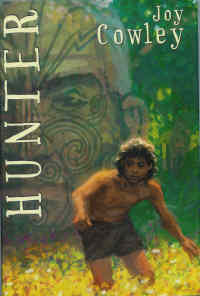
Book 8 - Hunter by Joy Cowley - New Zealand


A classic survival story with a interesting time shift twist. Joy Cowley sets her story in the remote area of Fiordland in the South Island. The first character we meet is a 15 year old slave called Hunter in the year 1805. He is a gifted tracker and hunter but because his tribe was conquered he was enslaved. He is taking a hunting party to find a Moa - a large, now extict flightlass bird. We then also meet 14 year old Jordan and her two younger brothers who are flying back to their family in the year 2005. Their plane crash lands in the same Fiord that Hunter was in and Jordan struggles to help her brothers survive in the treacherous conditions. Somehow Hunter senses Jordan's needs through time and somehow she intuitively hears follows his guidance to shelter in a cave, ways to find food and how to care for her seriously injured brother.

Interesting links between the two times and the desperate need of Hunter and Jordan to escape their circumstances to survive.

See great student reviews from Aquinas College


Saturday, July 23, 2011

Book 7 The thousand Autumns of Jacob de Zoet by David Mitchell - Japan

OK this is older young adult fiction (if that is possible) shall we say adult fiction? I do think students in their late teens will enjoy this book and they would also get great value from David Mitchell's essay about historic fiction as a genre at the back of the book.

To describe this book as an eighteenth century love story is too limiting. It takes place in Edo-era Japan. The Dutch East India Company is stationed on the 120 metre-long artificial island . Theirs is the most significant contact Japan has had with the outside world since Portuguese missionaries were expelled. Dutch trade on the island is now the one opening Japan has to the outside world – a tiny valve for the exchange of goods and ideas.
Jacob de Zoet arrives on the island charged with cleaning up the accounts of an operation riddled with corruption. He is a man of integrity whose dedication to his role causes others around him to distrust and resent him. He meets a beautiful but scarred Japanese midwife who has been granted some limited contact with European medicine, Jacob finds himself in love but his affection is forbidden by tradition, culture, politics and law.
This unlikely and ill fated love story becomes more complicated against a back drop of Japanese political manipulation and the English navy advancing upon Japan. Mitchell also explores the idea of language acquisition, translation and interpretation. Cross cultural relationships in business, education and diplomacy between the Dutch and Japanese and later the Dutch and the English create dramatic storylines as well.
This is another book with its own website - with all the added extras - take a look.

Tuesday, July 19, 2011

Book 6 - Between Shades of Gray by Ruta Sepetys - Siberia

It sounds awful to say that I really enjoyed this book especially when you learn that it is about the sadness and horror of a family from Lithuania being sent to Siberia in the 1941 Stalinist purge that happened in the Baltic nations of Latvia, Lithuania and Estonia. It was a brutal, inhumane suppression of people. The narrator is the main character, Lina, a fifteen year old girl who has been nutured in a home that encourages her artistic talent and intelligence. Lina is such a realistic character, coping with the conflicting emotions and confusions that came with  being a victim of this regime. I also loved Lina's mother's determination to try to be positive and not let her circumstances rob her or her children of their dignity. Strength pf character is personified in this character.

Not surprisingly this is a New York times best seller - it has its own website where you can read excerpts and read how Ruta Sepetys was inspired to write this account of people lost in a silent war.

Take a look at this great review on yareads from Christine.

This book and its characters will stay long in my memory.

Saturday, July 2, 2011

SLANZA conference - everybody getting there

This morning I leave for my Summer vacation in New Zealand's winter. I am heading home to the other world I mentioned in my profile. While I am there I will be attending the SLANZA (School Library Association of New Zealand Aotearoa) conference. One of the key note speakers is Joyce Valenza. I love these conferences - librarians are are people who are so generous in sharing their ideas and expertise.

I am still a SLANZA member. I appreciate this association and all that it does for shool libraries and librarians. Networking is vital for our profession and I really value my colleagues in NZ and throughout the world. It reminds me of the quote

Cooperation is the thorough conviction that nobody can get there unless everybody gets there. ~Virginia Burden

Friday, July 1, 2011

Book 5 - Sunrise over Fallujah by Walter Dean Myers - Iraq

I don't usually read "war" stories but I am challenging myself to read more Young Adult novels so I thought I would increase the challenge by reading books from a variety of genres.

This book is no glorification of war or of the American way. It offers some very realistic views of what was happening for some of the young people fighting in Iraq. The story follows Robin "Birdy" Perry - a new recruit from New York's Harlem. He is not too sure why he enlisted but finds himself in a special unit called "Civilian Affairs". This unit is supposed to make friends among the locals and show the humane face of the US army. He faces the paradox of this assignment from the minute he arrives in Iraq.

Walter Dean Myers allows the voices of his Iraqi characters to raise the questions about this war. One leader says "Do you think that the people who have lived together for more years than your country has been in existence suddenly find it impossible? That the hatred has grown so quickly between Sunnis and Shiites that we must shoot and bomb each other? No, my friend." Another points out that by removing Saddam Hussein you just create more confusion "When you kill a camel it is better to cut off the body than the head," the old man said. "If you cut off the head then the camel doesn't know who he is." This book shows real stress in the motivation for the war and the execution of it. This is not a new war it is just another on top of the many wars already taking place in the land.

Birdy faces the fear, the anger, the grief and the confusion of  war with his unit. This is a compelling read.

For a look inside the book - Amazon
For a more in depth review - Teen Reads
For a student's review try this one from Jack posted in 2009