Showing posts with label education. Show all posts

Sunday, November 18, 2012

Blur 070.9

Blur How to know What's true in the age of information overload by Bill Kovach and Tom Rosenstiel

This book has stayed with me weeks after having read it. In the current time of economic uncertainty, conflict in the middle east and scandals with top politicians it is so important to be able to discern what is being presented to us in the media. This book provides not only the tools to do this but also very useful case studies and analysis. 

The authors offer 6 ways of skeptical knowing - 6 essential tools for interpreting the news - 
1. What kind of content am I encountering?
2. Is the information complete? If not, what's missing?
3. Who or what are the sources and why should I believe them?
4. What evidence is presented and how was it tested or vetted?
5. What might be an alternative explanation or understanding?
6. Am I learning what I need?

The final chapter of the book offers this hope declaration - I will let the writers tell you the story. John Dewey and Walter Lippmann debate about the whether people are capable of being free. Lippmann argued the public were ill equipped to be informed citizens. He also thought the press unable to  to inform the public. Dewey agreed with this critique of both press and public but asserted the only justifiable role for the press was to educate the public, to make them more able to participate in democratic society. "The press had no other claim to exist. Nor, incidentally, did education. Democracy could not be saved by losing faith in it. A century later, technology has caught up to Dewey's vision. The time for education has arrived."

There is my friend Dewey again. What a great way to begin my Delving into Dewey.

Journalism.org  review and six points

Saturday, November 10, 2012

Delving into Dewey

Two Mr Dewey's have a profound impact on my life as a Teacher Librarian. They were contemporaries of one another but not related in any way. I wonder if they even met each other. 

Melvil Dewey (December 10, 1851 – December 26, 1931) - the man who invented a method of organising libraries known as the Dewey Decimal System. He was one of the founders of the American Library Association - am Association which has been of great help to me personally and to thousands of others. Project Gutenberg has his Dewey Decimal System pamphlet online. In the course of our work processing books ready for borrowing we refer often to our copy of the Abridged Dewey Decimal Classification and Relative Index to help us know where to place a book in our collection. For a librarian it is important to place books of a similar subject together so our borrowers can find the title they want and browse the shelves for similar titles.

John Dewey (October 20, 1859 – June 1, 1952) was an educator who brought in many social and educational reforms. His work My Pedagogic Creed was published in the School Journal vol. 54 (January 1897), pp. 77-80. It has so many things in it that I agree with. I work in a school which has the word "community" in its name. Dewey valued school as a community and wrote, "I believe that much of present education fails because it neglects this fundamental principle of the school as a form of community life." He also challenges the teacher to be active in helping to create proper social life he wrote,  "I believe, finally, that the teacher is engaged, not simply in the training of individuals, but in the formation of the proper social life.
       I believe that every teacher should realize the dignity of his calling; that he is a social servant set apart for the maintenance of proper social order and the securing of the right social growth." I immediately think of the mission of the IB which is more than its educational programmes and certificates. On its website it states, "At our heart we are motivated by a mission to create a better world through education. We value our hard earned reputation for quality, for high standards and for pedagogical leadership. We achieve our goals by working with partners and by actively involving our stakeholders, particularly teachers.We promote intercultural understanding and respect, not as an alternative to a sense of cultural and national identity, but as an essential part of life in the 21st century.The International Baccalaureate aims to develop inquiring, knowledgeable and caring young people who help to create a better and more peaceful world through intercultural understanding and respect."

Apart from my musings here - where is all this leading? Having completed my "Around the World in 80 books" challenge I decided I would try in expand my non-fiction reading. I have been using LibraryThing to catalogue the books I read for school since November 2007. I have 831 books catalogues so far. I can see them according to Dewey classification and less than half are nonfiction, which is not surprising due to my love of fiction. My goal this academic year is to read high interest non-fiction which I hope I can encourage my colleagues and students to read. I will, of course continue with my fiction reading but now I am looking for the high interest, high quality non-fiction as well. 

I think the two Mr Dewey's would approve.

Wednesday, October 3, 2012

Book 75 - The Queen of Water by Laura Resau and Maria Virginia Farinango - Ecuador

As you can see this novel is based on a true story. Pictured below are Laura Resau and Maria Virginia Farinango. This is a fictional story based on the life of Virginia. The main character is called Virginia and we meet her as she is turning 7 years old. She lives with her family in an Andean village in Ecuador. She works in the fields all day with her family. They are called "longa tonga" or stupid Indians by the ruling class of mestizos - the Spanish descendants of the conquistadors  Virginia at age of seven is taken by a mestizo couple to care for their baby and do the household chores. They live in a city a long way from Virginia's home village. The wife terrorises Virginia and often beats her mercilessly. The husband calls her his 'hija' or daughter. Virginia spends her first year plotting ways to run away but as time goes by she gets used to her life, she likes the baby she is raising and this couple lead her to believe her family do not want her.


Virginia's spirited self belief is amazing and she dreams of a different future. She demands to be taught to read and once she does she secretly reads all of the books in the house - including the books the wife is using as a Biology teacher in a high school. When she finally does have the courage to break free from this family Virginia's determination to make a life for herself leads her to hard work but great success.

Laura Resau's website promoting the book
Book trailer by a student at Hillsborough County Public Schools 


Thursday, January 19, 2012

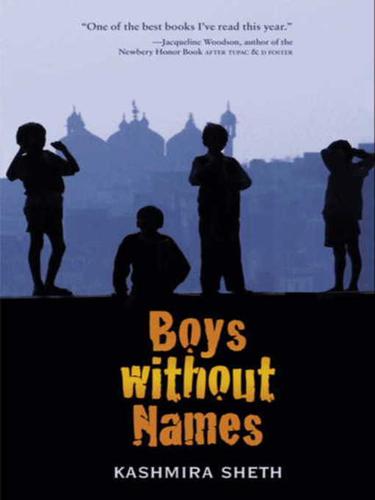
Book 35 - Boys without names by Kahmira Sheth - Mumbai, India

This is the story of a storyteller - an eleven year old boy called Gopal. He loves to read and write and tell stories to his siblings. His is not an easy life in a poor rural village in India. His family cannot pay their debts so they have to flee in the middle of the night - looking for a better life in Mumbai. Gopal cannot say good-bye to his friend, he leaves hoping for a fresh life in the big city.

When Gopal meets a strange youth near his Uncle's shack who offers him work he jumps at the offer, knowing anything he can bring home will help his family. But it is a trick and Gopal finds himself locked away in a shed with other boys gluing beads onto photo frames. The boys are forbidden to talk or to call each other by their names. Gopal quickly creates nicknames for all the people - the strict and cruel foreman, each of the boys. His story telling abilities soon bring him friends but there are some who see his ability to read and write as a real threat. Locked away from his family, in squalid working condition, Gopal discovers an inner strength and a hope that does not fade despite his circumstances.


I recommend this book for so many reasons. It has a very real issue at its heart - child slavery. It is very well written. It will make for great discussion with all who read it.

Kashmira Sheth's Blog

An interview with Kashmira Sheth