After our day with Kath Murdoch on Monday, my colleagues - Serife and Pla and I spent an hour dreaming about these question - how can we make our library an Inquiry Library? If our colleagues are Inquiry Teachers how can we be Inquiry Librarians? We thought of lots of great ideas and many of them you will see through this blog.
For some of our inspiration we will using wonderopolis
Wednesday, November 28, 2012
Sunday, November 25, 2012
Lose a weekend, gain renewed passion
I just spent my whole weekend at a workshop. Friday night arrived and I was tired. Construction work in Taksim had added a few hours to my usual long hours of weekly commutes. I was holding off a cold. I had a week of extra school meetings. The days are getting shorter and.... well I think you get the picture. So the prospect of spending my whole weekend in a seminar room in a hotel was not very appealing. Then Saturday morning I was challenged to rethink my entire professional practice.
Kath Murdoch is a leading light in the area of learning by inquiry. Right from the start she invited us to think of ourselves as inquirers. I started to wonder how to be an inquiry teacher and then more than that how can I be an inquiry librarian? I would love to have inquiry at the heart of everything I do. How can I invite more student voice? How can I change what I do in the library to invite more student discovery? What thinking routines should I include to enable my students to grow as thinkers and inquirers?
 |
| Slide showing some great questions |
 |
| Two kiwi librarians learning together |
I am not tired any more. I am excited to try as many strategies and ideas as I can. I have challenged myself to try out one new idea a week. Take one step no matter how small towards being an inquiry librarian. Get ready to share this journey, the successes and the mistakes that will lead to more learning. I can't wait to get started. I can't wait to chat with my colleagues who will be at a one day workshop Kath is running at our school tomorrow. I am curious to see how I can change, learn and grow.
Thanks so much to Kath and Kelly for helping me get started on this learning journey.
Sunday, November 18, 2012
Blur 070.9

Blur How to know What's true in the age of information overload by Bill Kovach and Tom Rosenstiel
This book has stayed with me weeks after having read it. In the current time of economic uncertainty, conflict in the middle east and scandals with top politicians it is so important to be able to discern what is being presented to us in the media. This book provides not only the tools to do this but also very useful case studies and analysis.
1. What kind of content am I encountering?
2. Is the information complete? If not, what's missing?
3. Who or what are the sources and why should I believe them?
4. What evidence is presented and how was it tested or vetted?
5. What might be an alternative explanation or understanding?
6. Am I learning what I need?
The final chapter of the book offers this hope declaration - I will let the writers tell you the story. John Dewey and Walter Lippmann debate about the whether people are capable of being free. Lippmann argued the public were ill equipped to be informed citizens. He also thought the press unable to to inform the public. Dewey agreed with this critique of both press and public but asserted the only justifiable role for the press was to educate the public, to make them more able to participate in democratic society. "The press had no other claim to exist. Nor, incidentally, did education. Democracy could not be saved by losing faith in it. A century later, technology has caught up to Dewey's vision. The time for education has arrived."
There is my friend Dewey again. What a great way to begin my Delving into Dewey.
Saturday, November 10, 2012
Delving into Dewey
Two Mr Dewey's have a profound impact on my life as a Teacher Librarian. They were contemporaries of one another but not related in any way. I wonder if they even met each other.
Melvil Dewey (December 10, 1851 – December 26, 1931) - the man who invented a method of organising libraries known as the Dewey Decimal System. He was one of the founders of the American Library Association - am Association which has been of great help to me personally and to thousands of others. Project Gutenberg has his Dewey Decimal System pamphlet online. In the course of our work processing books ready for borrowing we refer often to our copy of the Abridged Dewey Decimal Classification and Relative Index to help us know where to place a book in our collection. For a librarian it is important to place books of a similar subject together so our borrowers can find the title they want and browse the shelves for similar titles.
John Dewey (October 20, 1859 – June 1, 1952) was an educator who brought in many social and educational reforms. His work My Pedagogic Creed was published in the School Journal vol. 54 (January 1897), pp. 77-80. It has so many things in it that I agree with. I work in a school which has the word "community" in its name. Dewey valued school as a community and wrote, "I believe that much of present education fails because it neglects this fundamental principle of the school as a form of community life." He also challenges the teacher to be active in helping to create proper social life he wrote, "I believe, finally, that the teacher is engaged, not simply in the training of individuals, but in the formation of the proper social life.
I believe that every teacher should realize the dignity of his calling; that he is a social servant set apart for the maintenance of proper social order and the securing of the right social growth." I immediately think of the mission of the IB which is more than its educational programmes and certificates. On its website it states, "At our heart we are motivated by a mission to create a better world through education. We value our hard earned reputation for quality, for high standards and for pedagogical leadership. We achieve our goals by working with partners and by actively involving our stakeholders, particularly teachers.We promote intercultural understanding and respect, not as an alternative to a sense of cultural and national identity, but as an essential part of life in the 21st century.The International Baccalaureate aims to develop inquiring, knowledgeable and caring young people who help to create a better and more peaceful world through intercultural understanding and respect."
Apart from my musings here - where is all this leading? Having completed my "Around the World in 80 books" challenge I decided I would try in expand my non-fiction reading. I have been using LibraryThing to catalogue the books I read for school since November 2007. I have 831 books catalogues so far. I can see them according to Dewey classification and less than half are nonfiction, which is not surprising due to my love of fiction. My goal this academic year is to read high interest non-fiction which I hope I can encourage my colleagues and students to read. I will, of course continue with my fiction reading but now I am looking for the high interest, high quality non-fiction as well.
I think the two Mr Dewey's would approve.
Saturday, November 3, 2012
80 books read in Around the world in 80 books
So I have finished my challenge - 80 Young Adult books read in just over one year.Apart from the magic number 80 what has been achieved?
I know more YA books in our collection. On Friday I spent 15 minutes with some grade 6 girls browsing the shelves and chatting about what we had read. It started with one girl asking me for a recommendation and as we browsed and chatted the crowd grew. I hadn't read all the books we found but the ones I had read I was able to speak about from the heart. This is such a powerful way to help students develop a love of reading for themselves. It is mentioned in The Book Whisperer as a powerful way to help students access the riches of the library. And it is fun....
I have developed a reading habit. I love to read but I now have a commitment to read the books in our collection to pass them on to others. We are a k - 12 school and our library caters for 3 year olds through to adults. I have a huge variety of ages, cultures and languages to cater for. I want to connect people with books, good books and to do so I need to read them. So I will continue with this reading habit and start a new challenge.
I realise much of our collection has roots in the USA. Just look at the Google Map I kept as I read. I must ensure that our collection is truly international. That is quite a challenge when the school's preference is to source all materials, including books, from the USA. We are about to enter a new budget and ordering round for next year. I intend to try to ensure the materials I purchase are international in nature and content.
Next Thursday we begin our Professional Learning Group again for the new academic year. The first meeting will be new books in our library that support professional growth. These will not just be about how to teach but also books that encourage thought and curiosity on our teaching subjects. I will challenging myself and my colleagues to read more in order to bring depth and breadth to our content knowledge. I would love to see a culture of reading throughout the school. Let's see what happens next....
Wednesday, October 31, 2012
Book 80 - The Danger Box by Blue Balliet - Three Oaks, Michigan, USA
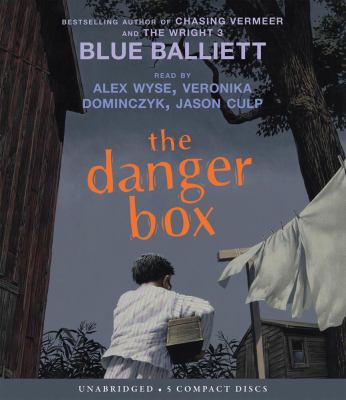
How can a legally blind boy solve a mystery? Zoomy is legally blind - his world can be scarey sometimes as things come in and out of focus. He lives with his grandparents who have taught him how to make lists to help bring some order and predictability into his world.
One evening Zoomy's father returns driving a stolen car, bringing a mysterious box and danger into their quiet lives. This is the first time Zoomy has met his his absent father and he is not sure he likes the way Buckeye creates havoc for his family.
Zoomy's grandfather is an antiques dealer and he takes the box to his shop but not before Zoomy, a keeper of notebooks himself, asks if he can read the notebook they found inside the box.
The notebook holds many mysteries for Zoomy who spends time at his library trying to discover what the notebooks is all about. While at the library Zoomy meets a true friend in Lorrol, who is at Three Oaks for the summer vacation. Together they begin to work out that the notebook is very precious indeed and written by a famous man who not unlike Zoomy is full of self doubt and uses the notebook to bring order into his life.
Throughout the novel there are issues of "The Gas Gazette" written by Zoomy and Lorrol with clues as to the identity of the notebook writer.
Blue Balliet speaking about her novel
Monday, October 29, 2012
Book 79 - Hot House by Chris Lynch - USA

When is a hero not a hero? When it appears that there is more to the story. This novel expertly explores the depth of loss the death of a parent can bring. Russ remembers the wonderful times he had with his father. Then, as the fire investigation report becomes public, Russ is forced to acknowledge the pain his father lived with daily both physically and emotionally. Chris Lynch does pull any punches when it comes to the toll fire fighters and their families pay as they work in emergency rescue situations. He questions the public's loyalties and expectations of these heroic people.
Teenreads review by Norah Piehl Interview with Chris Lynch thanks to Harper Teen
60 second recap views about the book
Subscribe to:
Posts (Atom)